Where the Bars Drop to Zero: Three Border Stays Built for Doing Very Little
There is a particular kind of weekend that begins with a hot tub and ends with three people scrolling at the table. This is not that weekend.
The Welsh borders are unusually well supplied with the other sort of stay: small, deliberate places where the wi-fi is a rumour and the entertainment is a woodburner, a view and whoever you brought with you. Not because the owners are preppers, but because the buildings themselves — a chapel, a hill farm, a cabin in larch — never had room for a bar or a lobby or a screen, and nobody saw fit to bolt one on afterwards.
Here are three we keep coming back to, with the honest practicalities attached: the nearest pub, the rainy-day fallback, and the small print that catches people out.
Switched off, not cut off
Worth saying plainly: low signal is not the same as no help. All three of these have electricity, hot water and either a landline or a patch of 4G on the top step if you stand at the correct ridiculous angle. You can call a doctor. You just can't idly refresh a news app at eleven at night without making an effort.
That effort is the whole point. When checking your phone means standing in a field, you stop checking it — and by Saturday afternoon you have remembered what you used to do with your hands.
Capel Bach: the chapel with the very high ceiling
A converted chapel on the western edge of the Black Mountains, all arched windows and a ceiling that goes up further than seems structurally sensible. One big room downstairs, a mezzanine above, underfloor heating, a long table, and a shelf of books left by previous guests with notes in the margins.
Sleeps: two, comfortably, or four if two of you are happy on the sofa bed.
Nearest pub: fifteen minutes down the valley to a stone-floored inn that does pie and chips and stops serving at half eight sharp. Ring ahead in winter; nobody wants to drive back up that lane on a whim.
Rainy-day backup: Hay-on-Wye is twenty-odd minutes away. Booth's has a cinema tucked in the back of the bookshop, Hay Castle will eat an afternoon, and there is always one more second-hand bookshop than you remembered.
Caveats: the lane is single-track with a steep final bend and low-slung cars hate it. Two-night minimum, no dogs, and the mezzanine stairs are open-tread — fine for most, not for anyone unsteady on their feet.
The small pleasure: no curtains on the east windows, because there's nothing out there but hillside. You wake with the light instead of an alarm. On the first morning, everyone is up by half seven and mildly baffled about why they feel so well.
Ty'r Ffridd: the farmhouse at the top of the track
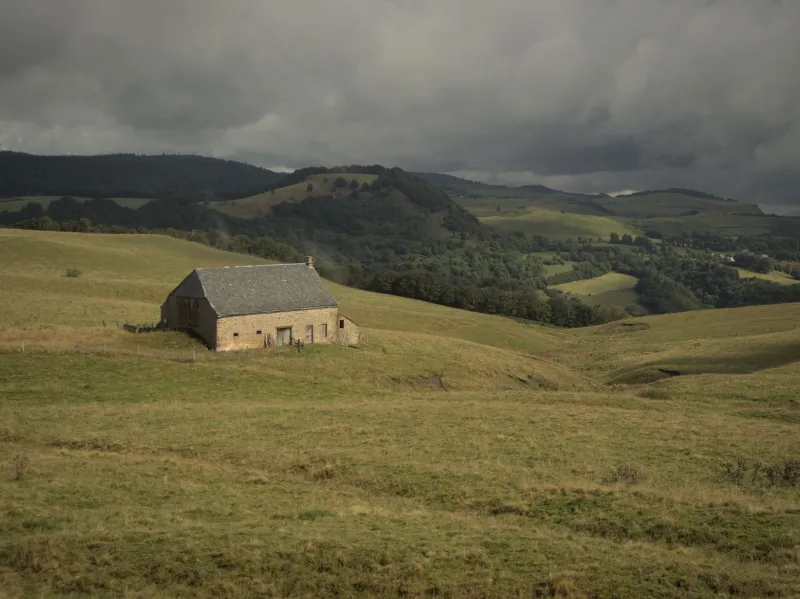
Half a mile of rutted track above a valley, walls thick enough to lose a doorbell in, and an oil-fired range that takes an hour to come up to temperature and then heats the entire kitchen. It smells of woodsmoke and old wool. There is a boot room, which tells you most of what you need to know.
Sleeps: four, in two proper bedrooms with proper beds.
Nearest pub: the village one, twenty minutes down the hill on foot. Take a torch, and ask nicely at the bar — a lift back up is usually arranged without much arm-twisting.
Rainy-day backup: this is the one to book if the forecast is grim. Long table, jigsaw shelf, a decent stock of saucepans, and Talgarth's shops a short drive away for supplies. The Wye Valley Walk passes below the farm; in drizzle, do the short version and claim the moral victory.
Caveats: the track is not for the nervous, and not for anything without a decent amount of ground clearance. Farm vehicles use it too. Signal genuinely vanishes past the gate; there's a landline, and the owners ask you to text from the bottom of the hill so they know you're in.
The small pleasure: the tin bath in front of the range, filled from the hot tap and a kettle, is not remotely glamorous and is easily the best bath in the borders.
The Larch Cabin: one room, one woodburner
A single room of larch cladding in a hazel wood, with a raised deck, rain on a tin roof, a composting loo in its own little shed and a shower that is genuinely hot provided you're organised about it. Off-grid-adjacent rather than off-grid: there's a socket for the kettle and a light that works.
Sleeps: two, and two only.
Nearest pub: a mile and a half across fields on a footpath that is lovely in daylight and a bad idea after the third pint.
Rainy-day backup: honestly, the cabin is the backup. Take a cookbook, a deck of cards, a decent bottle and the willingness to do nothing at all.
Caveats: no fridge beyond a cool box, a two-night minimum that stretches to three in summer, midges in June, mud in February, and a walk in from the car in all weathers. Pack a rucksack, not a wheelie case. You will feel stupid otherwise.
The small pleasure: reading by lamplight. Not for the romance of it, but because at some point in the evening the phone battery becomes a resource to be rationed, so you put it down and pick up the book instead.
Building the weekend around it
Friday: arrive before dark. This matters more than any other instruction on this page. Shop in Hay on the way through — cheese and bread from the deli, something to roast from the butcher, a bottle from the wine shop — then cook slowly and eat late.
Saturday: walk without a destination. The Gospel Pass, a stretch of Offa's Dyke Path, a loop up onto the Black Mountains or a flat amble along the Wye; all of them are within half an hour. Then a pub lunch, then a fire, then bed by ten because there's nothing else to do and it turns out that's a luxury.
Sunday: leave by eleven, as asked, and stop somewhere on the way home — a churchyard, a farm shop, a second pub. The trick is not to rush the last bit.
Before you book
Ask about the access track before you pay, not on the day. Check whether firewood is included or sold by the barrow. Take a torch, a power bank and offline maps, and carry cash for honesty boxes. Most of these places ask you not to arrive early, and all of them ask you to leave the place exactly as you found it.
And do one thing before you set off: tell the people who need to know that you'll be slow to reply. That message, sent on Friday afternoon, is the last useful thing your phone will do all weekend.