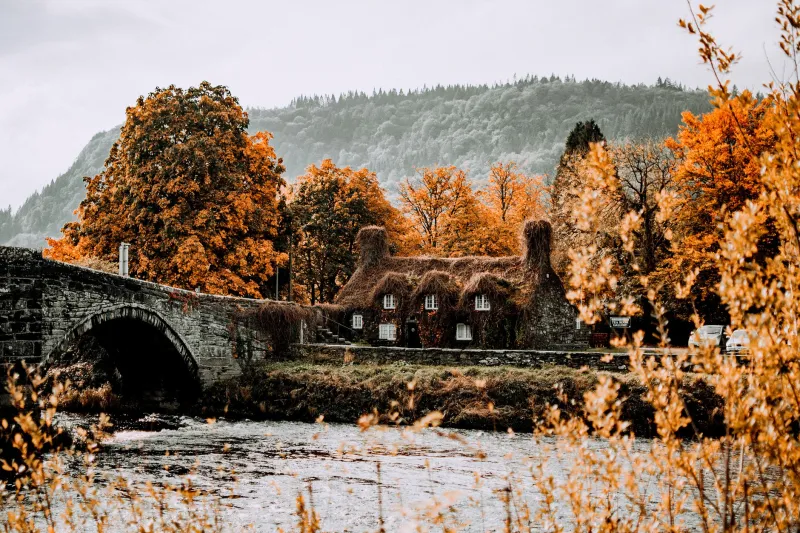
Leave the Engine Cold: Three Border Stays You Reach on Foot
Photo: Benjamin Williams Leader, Public domain, via Wikimedia Commons
There is a particular sound a weekend makes when it starts with a car door closing and then nothing else. No engine, no reverse beep, no gravel crunch under tyres. Just boots on tarmac, a rucksack shifting on your shoulders, and the low grey quiet of a border lane in November. The last mile is on foot—and that is rather the point.
A stay you walk into is not an endurance test. We are talking ten, twenty, maybe twenty-five minutes on a farm track or a footpath, not a full day on the Brecon Beacons. But that short stretch does something useful. It puts a clean edge between the drive and the weekend. By the time you reach the door, the admin of the journey has fallen away. You are already moving at the right speed.
Why the car can stop early
Most Welsh Borders hideaways are reached by narrow lanes, and many farms and hamlets have nowhere sensible to leave a car overnight. Rather than wrestle a hatchback into a gatehole, some hosts ask you to park at a marked lay-by, village hall or farmyard and walk the final stretch. In winter this needs a little more thought than in June, but it is hardly expedition territory. The trick is to treat the last mile as part of the stay, not as an inconvenience bolted onto the end of the drive.
If you are booking this kind of break between now and spring, ask three questions before you set off: exactly where should the car go, what is the path like after rain, and what should you do if you arrive after dark. Good hosts will send a short arrival note. Read it properly. The border lanes are not the place to discover that your booking confirmation is still sitting in an email folder with the oven instructions.
The bothy above Llanthony
The first is a small stone bothy tucked above the valley floor near Llanthony, reached by a footpath that leaves the lane at a metal gate. In daylight it is a pleasant amble with the Black Mountains doing their brooding thing on either side. In winter, give it respect. The path is rough in places, and after a week of rain the middle section holds water like a sponge. Walking boots and a proper torch are not optional extras here; they are the price of admission.
Leave the car in the agreed spot, swing the rucksack onto your back, and walk. The reward is a room with thick walls, a small stove and a window that gives you nothing but hills. There is no shop within easy reach, so pack as if you mean it: milk, bread, something hot for supper, a flask for the morning. The walk in is short enough to carry a decent bottle of red, but long enough that you will rethink the cast-iron frying pan.
The loft at the end of the farm track
The second is a converted loft on a working farm in the Golden Valley, where the tarmac gives way to a track and the track gives way to a yard. You park by the lower barn and walk the last fifteen minutes past a cattle shed and a stand of ash trees. The host may offer a wheelbarrow. Take the wheelbarrow. There is no badge of honour in carrying a week’s worth of luggage when someone is handing you a wheel.
This one suits a Friday-night arrival if you are coming from the Midlands or the south-east. Leave the car, strap a headtorch to your forehead, and let the beam pick out the ruts. The loft is warm, simple and quiet, with a deep sill and a view you will only properly see the next morning. That first cup of tea, drunk while looking at a view you walked through in the dark, is one of the small pleasures of a winter break.
The cabin beyond the gate
The third is a timber cabin reached from a hamlet near Hay by a bridleway that climbs gently through oak and bracken. There is a village hall car park a few minutes from the path, and the host will tell you which corner is yours for the weekend. The walk is maybe twenty minutes at a steady pace, and it is the kind of path that rewards a slower rhythm: a stile, a muddy patch, a sudden view back over the Wye Valley.
Because the cabin sits off-grid-ish—wood burner, solar lights, a water supply that asks you not to linger in the shower—the last mile sets the tone. You arrive with less and settle into less. Bring a proper rucksack rather than a wheelie case, pack layers rather than options, and put the torch in the top pocket where you can find it without unpacking half your bag in the dark.
Pack for the last mile, not the whole weekend
The common mistake is packing for the car boot and then discovering you have to carry it. Be ruthless. One bag each, plus a small food bag, is plenty for two nights. Wear or carry your boots rather than packing them. Put a torch, a spare battery or power bank, and a waterproof layer at the top of the bag. A flask of something hot in the car is a small kindness to your future self when you arrive at the lay-by after a long drive.
For winter arrivals, add a bin bag for muddy boots, a dry bag for anything that must not get damp, and a printed copy of the arrival instructions. Mobile signal in the border valleys can be patchy. Do not rely on a screenshot you took three weeks ago and cannot now find.
If you are running late
Rain, roadworks and the general tendency of Friday traffic to behave badly can all eat into the last mile. If you are running more than half an hour late, message the host before you lose signal. Ask whether the path is still sensible after dark, or whether there is a closer drop-off point. Some farms will let you leave the car nearer the door if you are arriving very late; others will not. Either way, a quick message is better than a surprise.
And if you do end up walking the last stretch in the rain, so be it. The bothy stove, the farm loft kettle and the cabin’s wood burner will all be more welcome for it. The last mile is not a test. It is a handbrake turn for the mind—a short, deliberate slowing down before the weekend properly begins.